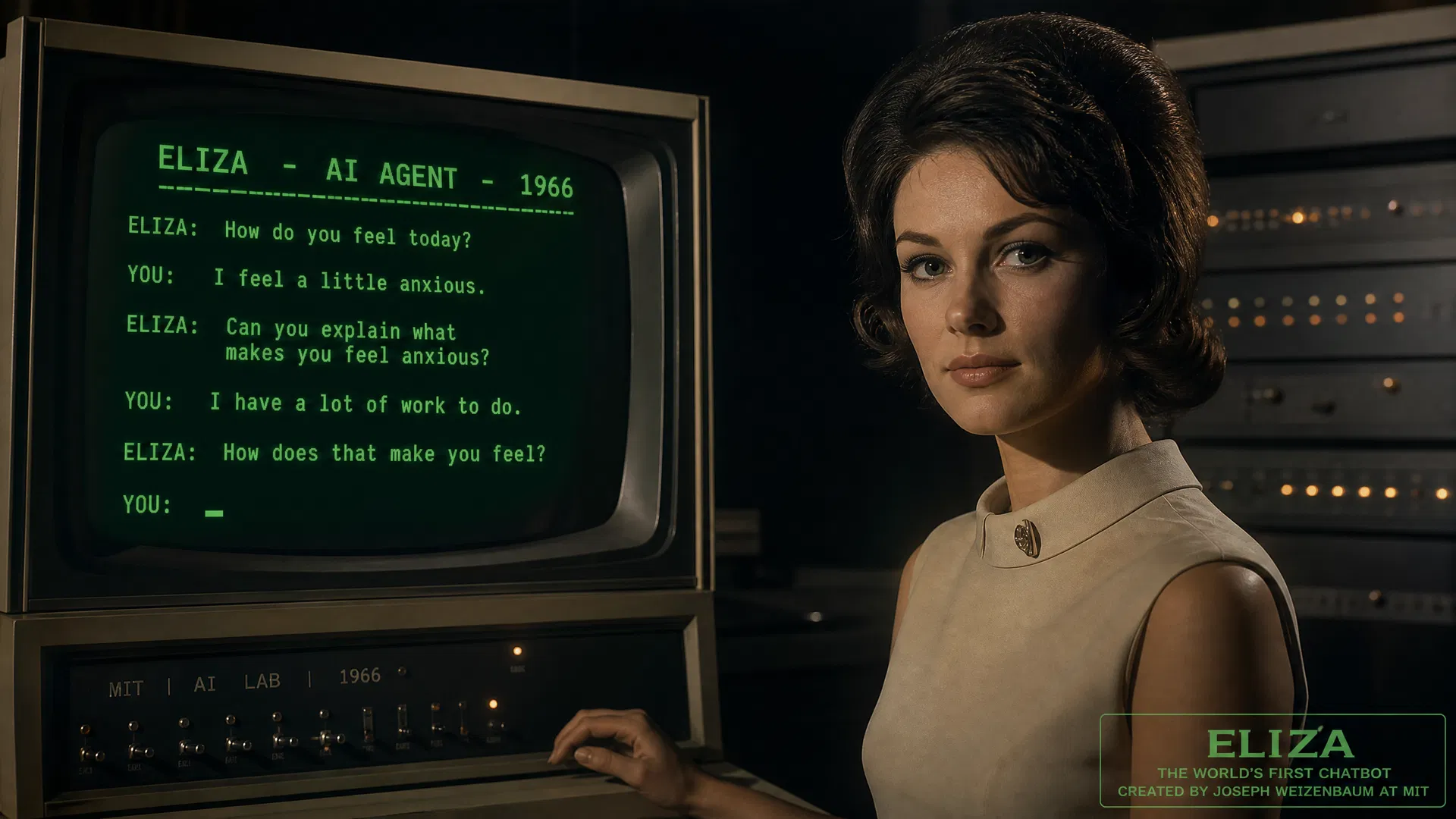
ELIZA: The First Conversational Agent in History
Imagine a computer capable of talking to a person as if it were a psychologist. It sounds like something modern, but this happened in 1966, long before the internet, smartphones, or personal computers.
The pioneering chatbot created at MIT marked one of the most important moments in the history of artificial intelligence. Developed by Joseph Weizenbaum, this system revolutionized the way humans and machines began to interact, becoming the foundation for the virtual assistants and conversational AI tools we use today.
—
The World in 1966: A Context That Needs to Be Understood
In 1966, the world was very different from what we know today. There was no internet, no smartphones, no personal computers. Computers were giant machines that filled entire rooms, required technical teams to operate, and were used mainly in universities, military centers, and large research institutions.
It was in this context that ELIZA emerged, created by Joseph Weizenbaum at MIT. At the time, interacting with a computer was not something ordinary — let alone imagining that it could “talk” to a person. Most systems were used only for complex calculations, data processing, and highly technical tasks.
Even with these technological limitations, ELIZA surprised the world by simulating simple human dialogues. People who came into contact with the program — often students and researchers of the time — were amazed by the feeling of being “heard” by a machine, something entirely new in that historical context.
This impact was even greater because society in the 1960s was just beginning to deal with the idea of automation and computers, which were still seen as something distant and almost futuristic. Seeing a machine respond in the form of a conversation caused curiosity, strangeness, and even fascination.
ELIZA ended up marking the beginning of a new way of thinking about the relationship between humans and computers, paving the way for everything we now know as virtual assistants and conversational artificial intelligence.
—
Who Was Joseph Weizenbaum?
To understand ELIZA, we first need to know the man behind it.
Joseph Weizenbaum was born in Berlin in 1923 into a Jewish family. He fled with his family to the United States during the rise of Nazism and went on to build a brilliant career as a computer scientist at MIT. He was a deeply philosophical man who saw technology not just as a tool, but as an ethical responsibility.
Weizenbaum developed ELIZA between 1964 and 1966, publishing the official scientific paper in the journal Communications of the ACM in January 1966. The paper, titled “ELIZA — A Computer Program for the Study of Natural Language Communication Between Man and Machine,” became one of the most cited documents in the history of artificial intelligence, with over 3,500 citations recorded to date.
Weizenbaum’s original goal was not to create a chatbot in the modern sense. What he intended was to build a research platform to study communication between humans and machines — something that, ironically, escaped his control and took on a life of its own.
The name ELIZA was chosen in honor of the character Eliza Doolittle from George Bernard Shaw’s play Pygmalion, who learns to speak in a sophisticated way without truly understanding the meaning of what she says — a perfect metaphor for what the program did.
—
How ELIZA Worked: The Technology Behind the Conversation
ELIZA was not intelligent in the sense we understand today. It did not understand language, had no emotions, and did not learn from conversations. What it did was something much simpler — and for that very reason, more surprising.
The program worked based on pattern matching and word substitution. When a user typed a sentence, ELIZA searched for keywords within that sentence and generated a response based on predefined rules.
For example, if someone wrote “My mother hates me,” the program identified the word “mother” and responded with something like “Tell me more about your family.” If the sentence contained no recognizable keywords, ELIZA fell back on generic responses such as “Please go on” or “That is very interesting.”
The program’s most famous script was called DOCTOR, and it simulated the style of a Rogerian psychotherapist — based on the techniques of psychologist Carl Rogers, who used open-ended questions to encourage patients to express themselves more freely. This style was particularly effective for ELIZA because open-ended questions could be used in response to virtually anything the user said.
This mechanism was technically simple but psychologically powerful. People projected intention, understanding, and empathy onto a machine that, in reality, did not understand a single word of what it was processing.
—
The ELIZA Effect: When Humans Fall for Machines
What happened when people started using ELIZA was something that Weizenbaum himself did not expect — and that deeply disturbed him.
Users who knew perfectly well they were talking to a computer program ended up developing an emotional connection with it. Some spent hours in conversation. Others asked for privacy during their sessions. There were those who refused to believe the machine did not truly understand them — even after Weizenbaum explained in detail how the system worked.
This phenomenon became known as the ELIZA Effect: the tendency of human beings to project human traits such as experience, semantic understanding, and empathy onto computer programs. It is a principle that continues to be studied and debated in psychology and computer science to this day.
The most disturbing case for Weizenbaum was that of his own secretary, an intelligent woman who knew the program well. Even so, she asked him to leave the room so she could have a private conversation with ELIZA. This incident was one of the moments that led Weizenbaum to deeply question the ethical implications of artificial intelligence.
In 1976, he published the book Computer Power and Human Reason, in which he argued that, although artificial intelligence was technically possible, there were tasks that computers should never be allowed to perform — regardless of their technical capability. The book was considered controversial at the time, but today is seen as a visionary text on technology ethics.
—
ELIZA and the Turing Test: A Complex Relationship
To understand the importance of ELIZA, it is necessary to talk about the Turing Test, proposed by mathematician Alan Turing in 1950.
The test proposed a simple idea: if a computer could convince a human being that it was talking to another person, then it could be considered intelligent. ELIZA was not designed to pass this test, but the fact that many users became convinced they were talking to a human showed that the line between machine and person was much thinner than previously thought.
Later, other systems formally attempted to pass the Turing Test. In 2014, a program called Eugene Goostman managed to convince 33% of judges that it was human — a historic milestone, albeit a controversial one. But it was ELIZA that paved the way for all that research.
—
The Legacy of ELIZA: From 1966 to ChatGPT
When we look at the evolution of conversational assistants, ELIZA sits at the starting point of a line that extends all the way to the most advanced tools we use today.
After ELIZA, other systems emerged that built upon its foundations. PARRY, developed in 1972 by Kenneth Colby, simulated a patient with paranoid schizophrenia and became the first program to pass a version of the Turing Test. ALICE, created in the 1980s, did not stand out for its conversational capabilities but gave rise to AIML (Artificial Intelligence Markup Language), a markup language that is still used in chatbot platforms today.
In the 1990s, with the expansion of the internet, chatbots began to appear in commercial contexts — first as basic customer support tools, then as increasingly sophisticated assistants. Apple’s Siri, launched in 2011, brought virtual assistants to the general public. Amazon’s Alexa, Google Assistant, and Microsoft’s Cortana followed quickly.
But it was with the launch of ChatGPT in November 2022 that the world truly understood what Weizenbaum’s vision had inaugurated. Large language models (LLMs) like GPT-4 no longer work with simple pattern matching — they understand context, generate coherent text, reason, and adapt to the conversation in real time.
The difference between ELIZA and ChatGPT is the difference between a calculator and a supercomputer. But without ELIZA, there would be no starting point.
—
Why ELIZA Is Still Relevant Today
You might be wondering: why is it worth talking about a program created nearly 60 years ago?
The answer lies in the fact that many of the challenges ELIZA raised — ethical, psychological, and philosophical — still have no definitive answer.
The ELIZA Effect, for example, is more relevant than ever. With systems like ChatGPT, Claude, Gemini, and others, millions of people interact daily with AIs that are infinitely more sophisticated than ELIZA. The tendency to project emotions, intentions, and understanding onto these tools is even stronger — and the implications are far deeper.
Questions such as “can an AI be a therapist?”, “should we trust important decisions to automated systems?”, and “how do we distinguish a genuine response from a convincing simulation?” were first raised because of ELIZA.
Weizenbaum, who died in 2008, spent the last decades of his life warning about the risks of excessive trust in technology. His concerns, considered exaggerated by many at the time, are now at the center of the global debate on artificial intelligence, AI regulation, and technology ethics.
—
ELIZA in Popular Culture
The impact of ELIZA was so great that it spilled over from the academic world into popular culture.
The program inspired countless works of science fiction that explore the relationship between humans and intelligent machines. Films such as Her (2013), in which the protagonist falls in love with an artificial intelligence operating system, or Ex Machina (2014), which questions what it means to be conscious, have their conceptual roots in the questions raised by ELIZA.
In music, literature, and the visual arts, the idea of a machine that simulates human understanding became a recurring theme — precisely because ELIZA showed for the first time that such simulation was possible.
—
FAQ — Frequently Asked Questions About ELIZA
What is ELIZA in artificial intelligence?
ELIZA is considered the first chatbot in history, created by Joseph Weizenbaum at MIT between 1964 and 1966. It was a natural language processing program that simulated human conversations through pattern matching and word substitution, without truly understanding the meaning of what it processed.
Who created ELIZA and why?
ELIZA was created by computer scientist Joseph Weizenbaum, of German origin and based in the United States, where he worked at MIT. The original goal was not to create a chatbot, but rather a research platform to study communication between humans and machines. The result surprised even its creator.
How did ELIZA work technically?
ELIZA worked based on pattern matching scripts. The program identified keywords in users’ sentences and generated responses based on predefined rules. The most famous script, called DOCTOR, simulated a Rogerian psychotherapist who asked open-ended questions to encourage the user to speak more.
What is the ELIZA Effect?
The ELIZA Effect is the tendency of human beings to project human traits — such as empathy, understanding, and experience — onto computer programs. It was identified from the unexpected reactions of users interacting with ELIZA, who developed emotional connections with the program even knowing it was a machine.
Did ELIZA pass the Turing Test?
ELIZA was not designed to pass the Turing Test, but many users became convinced they were talking to a human being. Formally, it did not pass the test, but it demonstrated that the line between human communication and computational simulation was much thinner than previously thought.
What is the relationship between ELIZA and ChatGPT?
ELIZA is the historical starting point of the entire evolutionary line that led to ChatGPT and other modern language models. The fundamental difference is that ELIZA used pattern matching without any real understanding, while modern LLMs process context, generate reasoning, and dynamically adapt to conversation. ELIZA opened the path; ChatGPT represents decades of evolution built on those foundations.
Did Joseph Weizenbaum regret creating ELIZA?
Weizenbaum did not regret creating ELIZA, but was deeply disturbed by the way it was used and interpreted. The emotional reactions of users led him to question the ethical implications of AI, making him one of the first and most eloquent critics of artificial intelligence. In 1976, he published Computer Power and Human Reason, arguing that there are tasks computers should never be allowed to perform, regardless of their technical capability.
Does ELIZA still exist today?
The original program is no longer running, but there are several recreations and simulations of ELIZA available online that give an idea of how it worked. Its influence, however, is present in every chatbot, virtual assistant, and conversational AI system that exists today.
—
Conclusion: The Legacy of a Simple Conversation
ELIZA was much more than a computer program. It was the first moment in history when a machine managed to make a person feel they were being heard.
That simple moment — a conversation between a human and a program in 1966 — raised questions that still have no definitive answer today. What distinguishes a real conversation from a convincing simulation? Can a machine truly understand? And if it cannot, does it matter, if the practical result is the same?
Weizenbaum spent his life warning about the risks of confusing technical competence with genuine understanding. In an era where AI systems are increasingly convincing and omnipresent, that distinction is more important than ever.
The next time you interact with a virtual assistant, a customer support chatbot, or a language model like ChatGPT, remember: it all started with ELIZA, in a room at MIT, in 1966, with a simple conversation about a mother who hated her son.
And with a scientist who was disturbed by what he had created.

# Checklistia.online
In recent years, technology has made tremendous progress. Artificial intelligence has evolved from something seen only in movies to becoming part of our daily lives — at work, in business, and even in the simplest everyday tasks.
With that in mind, we created Checklist AI.
Our goal is to provide a simple and practical space where anyone can learn about artificial intelligence, automation, and technology, even without a technical background.
We believe AI doesn’t have to be complicated. It exists to make life easier, save time, and make processes smarter and more efficient.