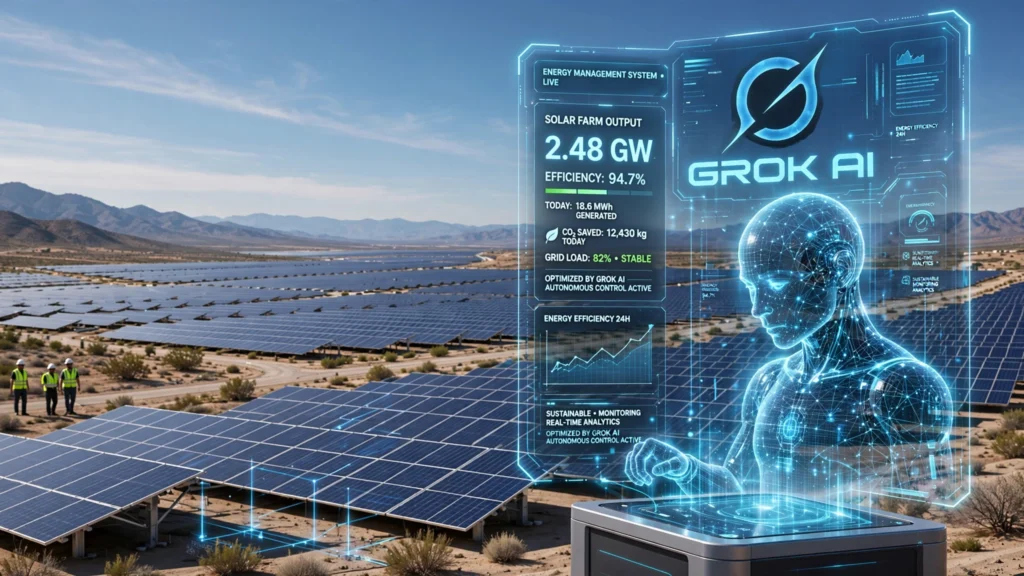
Artificial intelligence is no longer just software that answers questions or generates images. By 2026, it has also become a physical force, with real demands on electricity, water, and large-scale power infrastructure. No example illustrates this better than xAI, Elon Musk’s company behind Grok, and its data center complex known as Colossus. At the same time, and almost paradoxically, artificial intelligence itself is becoming one of the most powerful tools for making the energy sector more efficient — forecasting solar and wind production with greater accuracy and managing electricity consumption in real time.
This article explores both sides of that coin: on one hand, xAI’s energy infrastructure projects and what they reveal about the electricity appetite of cutting-edge AI; on the other, how that same technology is being applied to predict renewable energy generation and optimize consumption across increasingly complex power grids.
xAI Also Needs Electricity — A Lot of It
Before discussing how AI helps the energy sector, it’s worth acknowledging an uncomfortable fact: training and running large-scale AI models consumes amounts of electricity comparable to entire cities. That’s the backdrop for xAI’s energy infrastructure projects.
The Colossus complex, built by xAI in Memphis, Tennessee, and expanded into neighboring Southaven, Mississippi, began operating in July 2024 with roughly 100,000 Nvidia H100 GPUs, installed in a repurposed industrial building in just over one hundred days. That construction speed, described by Nvidia itself as extraordinary, became the project’s defining trait. In just over a year and a half, the cluster tripled in size: by early 2026, it spanned three buildings, housed roughly 770,000 GPUs, and reached approximately 1 gigawatt of installed computing capacity, with plans to reach 2 gigawatts in the years ahead — enough power to supply hundreds of thousands of homes.
To power that structure, xAI took an unconventional path: rather than relying solely on the public electrical grid, the company installed its own natural gas turbines on site, allowing it to operate largely independently of the grid while it negotiates higher-capacity connections with local utilities. This “off-grid” approach became a source of controversy: environmental advocacy groups found that xAI had operated dozens of turbines without the required permits, resulting in Clean Air Act violation lawsuits. In response to growing local resistance to gas-fired generation, the company acquired a former Duke Energy plant nearby, further reinforcing its own generation capacity.
This model of “building your own power plant next to the data center” has become, for better or worse, a reference point for the AI industry. Other tech giants bet on expanding their connections to the traditional grid; xAI bet on local, rapid generation, compressing into weeks what normally takes years.
Partnerships, Capacity, and the New Market for Computing Power
The scale of Colossus has turned it into a strategic asset that goes far beyond training Grok. In 2026, xAI began renting out computing capacity from its cluster to other AI companies, turning Colossus into a kind of shared infrastructure for the sector. Anthropic reached an agreement to rent all of Colossus 1’s compute capacity, while Google signed a multi-year deal to lease tens of thousands of additional GPUs, in an arrangement worth hundreds of millions of dollars per month, aimed at expanding the training capacity of its own models.
This shift is telling: energy infrastructure is no longer just an operating cost for AI — it has become a tradable product in its own right. Whoever controls enough energy to power tens of thousands of GPUs effectively controls one of the scarcest resources in today’s digital economy — in many cases, scarcer than the chips themselves.
From AI That Consumes Energy to AI That Makes It More Efficient
Against this backdrop of growing energy appetite, the second half of this story becomes even more relevant: artificial intelligence is also, today, one of the leading tools for making the power sector more efficient, more predictable, and cleaner. While AI data centers put pressure on the electrical grid, machine learning algorithms are helping integrate renewable sources into that same grid more intelligently.
The central problem with solar and wind power is variability. Unlike a thermal or hydroelectric plant, which produces energy relatively predictably, solar panels and wind turbines depend directly on weather conditions — clouds, wind, rain, temperature. That unpredictability has always been the main obstacle to a faster energy transition: grid operators must keep backup plants, usually thermal, ready to step in whenever renewable output drops unexpectedly.
How AI Forecasts Solar and Wind Production
This is exactly where artificial intelligence is changing the game. Machine learning models trained on large volumes of weather data, generation history, and satellite imagery can predict — with far greater accuracy than traditional statistical methods — how much solar and wind energy will be generated over the next few hours, days, or weeks.
In practice, this works by combining several layers of data:
- Real-time and historical weather data, including solar radiation, wind speed and direction, cloud cover, and temperature.
- IoT sensors installed directly on solar panels and wind turbines, continuously monitoring the physical performance of the equipment.
- Satellite imagery, used to anticipate regional weather patterns further in advance.
- The facility’s own historical operating data, which helps the model learn how that specific plant responds to different conditions.
With this data, deep learning algorithms can forecast generation scenarios across windows ranging from a few hours to several weeks, allowing grid operators to plan the best combination of energy sources to use at any given moment, well ahead of time.
The practical benefits of that predictability are significant:
Reduced energy waste. When solar or wind output is higher than forecast and the grid isn’t ready to absorb that surplus, part of that clean energy ends up being wasted. More accurate forecasts allow that surplus to be redirected into battery storage or toward industrial sectors with more flexible consumption.
Less dependence on backup plants. The more accurate the renewable generation forecast, the less need there is to keep thermal backup plants permanently on standby — which cuts operating costs and greenhouse gas emissions.
Predictive maintenance. Sensors combined with AI algorithms detect early signs of wear in wind turbine blades or dips in solar panel efficiency, allowing maintenance to be scheduled before failures or significant production losses occur.
Optimized physical positioning of equipment. In solar farms equipped with tracking systems, AI automatically adjusts panel angles throughout the day to maximize light capture, based on forecasts of sun position and atmospheric conditions.
In the wind sector, this combination of sensors, big data, and machine learning is already used to continuously analyze the performance of turbines, blades, and generators, extending asset lifespans even in adverse weather conditions while reducing maintenance costs.
Smart Energy Consumption Management
If generation forecasting solves the supply side, smart consumption management solves the demand side — and that’s where the concept of the smart grid becomes central.
Traditional electrical grids were designed around a simple model: a handful of large plants generate power, and that power flows in a single direction toward end consumers. That model no longer matches today’s reality, marked by thousands — soon millions — of small, distributed generators, such as residential solar panels, home battery storage, and electric vehicles capable of feeding energy back into the grid.
Managing that complexity manually is practically impossible. That’s why AI algorithms are increasingly taking on the role of an invisible conductor for modern power grids, coordinating renewable generation, battery storage, conventional generation, and flexible consumption in real time — across scales ranging from a single home to an entire city.
Among the most relevant applications of smart consumption management are:
Demand forecasting. By analyzing historical consumption data alongside variables like weather, time of day, day of the week, and even special events, AI can anticipate consumption peaks before they happen, allowing the system to be adjusted in advance.
Automated demand response. Consumers — industrial, commercial, and increasingly residential — can automatically adjust their consumption based on renewable energy availability, cutting usage during periods of scarcity and increasing it when there’s a surplus of solar or wind generation, often with no direct human intervention.
Automatic load balancing. In the event of a failure or overload, AI algorithms can automatically reorganize the grid’s topology, redirecting energy flow to prevent widespread outages.
Optimized energy contracts and purchasing. In deregulated energy markets, more and more companies use AI-driven predictive analytics to anticipate price swings and adjust their supply contracts, taking advantage of lower-cost periods and cutting operating expenses by up to 30% in some cases.
Automatic waste detection. Smart sensors connected to energy management platforms identify inefficient consumption patterns in real time — equipment left running unnecessarily, off-hours peaks, poor thermal insulation — allowing for immediate correction.
The combined result of these applications is a more resilient grid, cheaper to operate, and better able to absorb large volumes of renewable energy without compromising supply stability — exactly the kind of infrastructure that will be needed to sustain, among other things, the continued growth of AI data centers like Colossus itself.
AI’s Energy Paradox
This brings us to the most interesting — and most ironic — part of this story: the same technology putting unprecedented pressure on power grids worldwide is also the most promising technology for making those grids more efficient and sustainable.
xAI, with its growing appetite for gigawatts of computing capacity, exemplifies the demand side of that paradox: every new generation of GPUs, every expansion of Colossus, represents a leap in the amount of energy needed to train models like Grok. At the same time, advances in AI itself — many of them driven by companies like xAI, OpenAI, Google, and others — are accelerating grid operators’ ability to forecast, integrate, and manage renewable sources far more efficiently than was ever possible with traditional statistical methods.
This paradox has no simple resolution, but it points to a fairly clear path forward: as AI’s energy demand keeps growing, it becomes even more urgent to apply AI itself to the smart management of that energy — whether through more accurate renewable forecasting or through power grids capable of regulating themselves in real time.
What to Expect Through 2027
Several signals suggest this dual movement — more energy consumption by AI, more energy efficiency thanks to AI — is set to accelerate over the next few years.
On the infrastructure side, xAI has already signaled plans to expand Colossus beyond its current 2 gigawatts, with a stated goal of operating over a million GPUs. That growth is expected to continue relying heavily on local generation, including large-scale battery storage and potential partnerships with local utilities for water treatment and additional grid infrastructure.
On the energy efficiency side, the trend points toward deeper integration between artificial intelligence, the Internet of Things (IoT), and big data, forming what industry experts already call “Energy Management 4.0” — grids capable of forecasting generation and consumption with high precision, automatically redirecting energy between different sources and consumers, and substantially reducing dependence on fossil-fuel-based backup generation.
For businesses, governments, and consumers, the practical takeaway is clear: whoever invests early in AI-driven energy forecasting tools and smart consumption management systems will be better positioned to navigate a scenario where electricity demand — driven, among other factors, by the very expansion of artificial intelligence — is only set to keep growing.
Conclusion
xAI’s energy infrastructure projects, led by Colossus, show just how much cutting-edge artificial intelligence has also become a large-scale electrical engineering project. But that same energy-hungry technology is today one of the most effective tools for accurately forecasting solar and wind production and for intelligently managing electricity consumption across increasingly complex, decentralized grids.
Understanding AI’s dual role — as a voracious consumer of energy and, simultaneously, as an engine of energy efficiency — is essential for anyone trying to follow, invest in, or simply understand where the power sector is headed in the coming years. The energy transition and the AI revolution are no longer separate stories; increasingly, they’re the same story, told from two different angles.
This article is for informational purposes. Data on data center capacity, commercial agreements, and expansion projections change frequently — always verify official sources from xAI, SpaceX, and the utility companies involved before using specific figures in your own publications.
Extra battery that snaps onto your phone.
The Magnetic Power Bank 5000mAh connects via induction in seconds — no cables, no fiddly adapters. Just snap it on — the magnet does the rest, and your phone charges while you go about your day.
View on Amazon →Affiliate link — buying through it costs you nothing extra. FAQ ↓
5000 mAh
up to 7.5W
Lightning 5V/2A
Magnetic (MagSafe-style)
Made for people who hate loose cables in their bag
An accessory small enough that you’ll barely notice it in your pocket, but with enough charge to save your phone on a trip, at an event, or on a busier-than-usual day.
5000mAh backup
Charges your phone more than once, so you don’t have to worry about your battery percentage.
Turbo wireless up to 7.5W
Fast, convenient wireless charging — snap it on and it’s already charging.
Stable magnetic attachment
Compatible with the MagSafe system, it holds firmly to your phone without slipping.
Universal compatibility
Works with iPhone and other devices set up for magnetic charging.
Compact and lightweight
Fits in a pocket, bag, or backpack without adding weight or taking up space.
Regulatory certified
Registration No. 04127230063 — certified safety for everyday use.
What’s included
Magnetic Power Bank 5000mAh
Model MAX-0536, in white.
30cm iOS cable
For quickly recharging the power bank itself via the Lightning port.
Metal attachment ring
For phones without a built-in magnet, ensuring a secure magnetic hold.
Specifications
Certified compliant under registration No. 04127230063.
Charge in 3 steps
Recharge the power bank
Plug the included Lightning cable into any USB power source until the internal battery is full.
Snap it onto your phone
The magnetic system aligns and attaches itself automatically to the back of the device.
Let it charge
Wireless induction starts on its own — no extra cables needed.
Before you buy
Does it work with any phone?
It works directly with MagSafe-compatible iPhones. For other devices with wireless charging, just use the included metal ring to ensure a secure magnetic hold.
Do I need to carry another charger with me?
No. The power bank already comes with its own internal 5000mAh charge. You just need to recharge it before you leave home, using the included cable.
Is it safe to leave attached to my phone all day?
Yes. It’s certified compliant and built for continuous magnetic use, without overheating under normal usage conditions.
How many full charges does it give my phone?
With 5000mAh, it typically provides more than one full charge for phones with smaller batteries, depending on the model and the device’s power draw.
Is the metal ring necessary for iPhone?
No, if your iPhone is already MagSafe compatible. The ring is for devices that don’t come with a built-in magnet.
Never run out of battery away from home again.
The Magnetic Power Bank 5000mAh is available on Amazon, with shipping subject to availability by location.
View on Amazon →
# Checklist IA
En los últimos años, la tecnología ha dado un enorme salto. La inteligencia artificial ha dejado de ser algo de películas para convertirse en parte de nuestra vida diaria: en el trabajo, en los negocios e incluso en las tareas más simples.
Pensando en ello, creamos Checklist IA.
Queremos ofrecer un espacio sencillo y práctico donde cualquier persona pueda aprender sobre inteligencia artificial, automatización y tecnología, incluso sin experiencia técnica.
Creemos que la IA no tiene por qué ser complicada. Existe para facilitar la vida, ahorrar tiempo y hacer que los procesos sean más inteligentes y eficientes.